What's Wrong With My Garden?

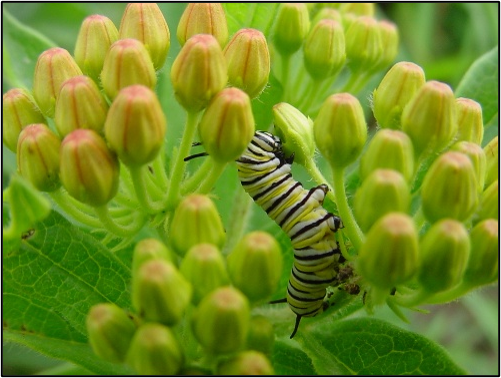
Oftentimes, our dreams of beautiful gardens are dashed this time of year when damage from insects, critters, and plant diseases starts to wreak havoc on our gardens and landscapes. Before you despair, here are a few things you can do to prevent further damage and to prevent damage in the future. 

There are many helpful online and smart-device apps available for identifying plants, insects, and plant diseases. This is a great place to start since you want to make sure before you start yanking a 'weed' or spraying a 'pest' that you know what you have is correctly identified. You can also reach out to MN Extension and their Master Gardeners for more information. Ask a Master Gardener | UMN Extension.

  54 Hits

Fall is a Great Time to Plant Pollinators!

If your spring planting plans didn't work out, there's still plenty of time! Planting native perennials in the fall reduces weeding and watering needs and even promotes earlier root establishment, giving them a head start on growing next spring! Check out this article from Blue Thumb to learn more about fall planting: Planting for Pollinators in Fall – Blue Thumb.

Most native plant vendors restock species for fall planting and are accepting plant orders now. Blue Thumb is also hosting its second annual in-person fall plant sale, with details listed above. For more information on pollinators, contact Jordi Johnson, Restoration Technician, at This email address is being protected from spambots. You need JavaScript enabled to view it..

  64 Hits

ACD's Keystone Endeavors

Photo: ACD's action wheel, identifying keystone endeavors for each of the foundational natural resources.

ACD has several keystone endeavors for each of the identified foundational natural resources: Surface Water, Ecological Resources, Groundwater, Soils, and Community and Operations. As we make progress on these endeavors, we have a lasting positive impact on the quality of life in Anoka County. 

  • Clean, plentiful water for drinking and other uses
  • Access to abundant high-quality outdoor recreation
  • Clean lakes and rivers
  • Full, but not overflowing, surface waters
  • Sustained diversity of plants and animals
  • Healthy functioning ecosystems
  • An engaged and invested public
  • Productive working lands
  • Vibrant local economy
  42 Hits
Tags:

Seasonally Dry: Low Water Levels in Anoka County 

As of August 4, 2026, the U.S. Drought Monitor classified all of Anoka County as being in moderate drought. However, the causes and effects of low water levels are often complex. Water levels reflect the combined effects of precipitation, snowmelt, temperature, groundwater conditions, and water use—and different water bodies can respond at different rates.

Where Did the Water Go?

During dry periods, less rain and snowmelt are available to replenish lakes, streams, wetlands, and groundwater. Heat waves (like we have experienced this summer) can intensify these conditions by increasing evaporation from open water and moisture loss from plants and soil. Hot weather also increases demand for lawn irrigation, placing additional pressure on groundwater supplies. When extreme heat, limited rainfall, and increased water use occur together, water levels can decline more quickly.

Groundwater is especially important in Anoka County, as ~94% of residents receive their drinking water from groundwater. Many local lakes and wetlands are closely connected to the water table, while groundwater also helps maintain streamflow between rain events. When groundwater declines, nearby surface waters may remain low even after rainfall. A single storm can temporarily improve conditions, but sustained precipitation is often needed for recovery. 

Photo: Coopers Lake in northern Anoka County. The red arrow marks the 2025 monitoring location, which was completely dry by summer 2026. The yellow arrow marks the relocated 2026 monitoring location.

Why Low Water Levels Matter

Shallow water warms more quickly, which can stress out fish and other aquatic life. Reduced streamflow may limit habitat and decrease the amount of cool, oxygen-rich water available to aquatic organisms. Pollutants and nutrients can also become more concentrated when less water is available to dilute them. Shorelines, rocks, stumps, and other hazards may become exposed, affecting boating and water access.

Wetlands naturally expand and contract, and some periodically dry out. These dry phases can benefit certain plants and wildlife. Long-lasting drought, however, can reduce habitat and lower shallow groundwater levels across the surrounding landscape. 

Photo: Exposed lakebed on Coopers Lake. Although prolonged drought creates serious concerns, occasional low-water periods can benefit shallow-lake ecosystems by exposing dormant seeds, encouraging native wetland vegetation, consolidating sediment, and creating valuable wildlife habitat.

 What Residents Can Do

Everyone can help reduce pressure on local water resources during these dry/hot conditions:

• Follow watering restrictions or schedules established by your city.
• Water lawns and gardens during the early morning, when less water is lost to evaporation.
• Water deeply but less frequently and allow established lawns to go dormant when practical.
• Repair leaking faucets, toilets, hoses, and irrigation systems.
• Use native plants adapted to Minnesota's climate that generally need less water once established.
• Maintain natural vegetation along shorelines to protect soil, provide habitat, and reduce polluted runoff.
• Avoid fertilizing immediately before rain and keep yard debris and other waste out of streets and water bodies.
• Do not dredge, fill, remove aquatic plants, or reshape shoreline or lakebed without first checking permit requirements.

Water Levels Can Recover—but It Takes Time
Water resources do not always respond immediately when rain returns. Soil moisture may need to recover before water can infiltrate deeply enough to recharge groundwater. Lakes, wetlands, and streams that depend on groundwater may therefore recover more slowly than rainfall totals alone suggest.

ACD and its partners track precipitation, lake and stream conditions, wetland hydrology, and groundwater levels throughout the county. Residents can find statewide drought updates through the MN DNR or contact Kris Larson, Water Resource Specialist, at This email address is being protected from spambots. You need JavaScript enabled to view it..

  64 Hits

Pollinators Making aSplash at the ACD Office

Photo: Pollinator garden at the ACD office.

A pollinator planting installed four years ago on a sunny and sandy slope at ACD's office is teeming with life as pollinators take advantage of its abundant blooms. It showcases the results of consistent watering, weeding, and supplemental plantings over the three critical years following the initial plug-planting effort. This area also contains a variety of additional flowering species that bloom during other seasons, along with grasses that provide habitat and shelter.

For more information, contact Breanna Keith, Restoration Ecologist, at This email address is being protected from spambots. You need JavaScript enabled to view it.. 

Photo: Right now, Wild Bergamot, Butterfly Weed, and Virginia Mountain Mint are feeding countless bees and butterflies, along with other beneficial pollinators such as the hummingbird-like Snowberry Clearwing Moth and Solitary Blue-Winged Wasps.
  194 Hits

Help Your Trees Beat the Heat!

Summer is here! Be sure to water your trees when the temps get hot and there hasn't been rain in a while. Sufficient watering is the best way to protect trees from stress that can lead to more serious insect or fungal diseases.

Long deep soakings in the mornings or evenings reduce water loss to evaporation. Placing mulch around the base of the tree in a "doughnut" shape can also help retain soil moisture. Smaller trees planted in the past year need 5-10 gallons of water every 2-3 days during extreme heat. Larger mature trees need a deep soak of the top 6-8 inches of soil once a week. 

Photo: An example of proper “doughnut” mulching on a tree. Allowing for moisture retention in the root zone without harming the trunk of the tree.
Photo: Tree watering bags slowly release water over 6-10 hours and can hold up to 20 gallons of water.
For more info on tree irrigation, check these links from the Minnesota DNR and the University of Minnesota Extension. Or contact Balin Magee, Restoration Technician, at This email address is being protected from spambots. You need JavaScript enabled to view it..
  186 Hits

ACD Works Hard to Save Money for Local Taxpayers

 ACD collaborates with water management entities that share jurisdiction in Anoka County. There is a collection of watershed districts and watershed management organizations (WMOs) that cover all of Anoka County and fit together like puzzle pieces. 44% of ACD overlaps with well-staffed watershed districts and WMOs. The other 56% have no staff and rely solely on ACD to serve as their staff. The extreme efficiency that results from this partnership is remarkable.

Photo: Anoka County is divided among 7 water management organizations, creating opportunities for strong partnerships. By combining efforts, local funding can be leveraged more effectively to maximize conservation outcomes and improve natural resources throughout the county.

 Wetland Regulation Specialist: Providing shared regulatory expertise reduces the need for independent hiring and consulting across approximately 10 local government units.

De Facto Technical Staff: ACD serves as the direct technical and operational staff for three watershed management organizations (Upper Rum, Lower Rum, and Sunrise River WMOs) covering approximately 60% of Anoka County.

$ 1.52 Million in Local Taxpayer Savings: By consolidating administrative overhead and technical staff under ACD's lean framework, this shared-services model prevents these three WMOs from needing to hire independent administrators and project managers. Operating these regions independently would cost local taxpayers an estimated $1.95 million annually. By anchoring them to ACD, local taxpayers save a net $1,526,452 annually.

For more information contact Chris Lord, District Manager, at Chris.Lord.AnokaSWCD.org.

  202 Hits

ACD's Meaningful Partnership with Conservation Corps MN

For organizations like ACD, working with a Conservation Corps of Minnesota & Iowa (CCMI) field crew can be much more cost-effective than using contractors for local conservation work and can also help train the next generation of natural resource professionals. The crews are supervised, equipped, and can be assigned to projects lasting from a single day to several months. 

Photo: ACD staff teaching a metro CCMI crew how to install a cedar tree revetment on a private shoreline of the Rum River. This metro crew will work with ACD throughout the summer, allowing them to continue their professional development.

Many young adults join CCMI for a mix of experience, training, student loan benefits, their love of the outdoors and the desire to make a difference. For many professionals in Minnesota, a season with CCMI is a stepping stone to landing permanent jobs in conservation, forestry, parks, or environmental science.

By working alongside the crew members, ACD staff can share their knowledge and experience to provide real mentorship. Check out the CCMI website to learn more about their mission and employment opportunities. For more information contact, Kris Larson, Water Resource Specialist, at This email address is being protected from spambots. You need JavaScript enabled to view it..

  226 Hits

Giving Aging Rain Gardens New Life in the Coon Creek Watershed

Rain garden revitalization is beginning in the Coon Creek Watershed as ACD moves forward with a project to restore aging stormwater infrastructure and enhance long-term water quality. 

Photo: An older rain garden installed in the Coon Creek Watershed.

 Funded through state Watershed-Based Implementation Funding, the initiative focuses on older rain gardens that still effectively capture and filter stormwater runoff but may no longer function as intended due to age and accumulated sediment. Rain gardens help capture runoff from streets, driveways, and rooftops before it reaches nearby water resources.

Interest in the program has been strong, with over 30 landowners volunteering their rain gardens for consideration, exceeding the number of sites funding can support. Site visits are currently taking place and will continue throughout June and July to evaluate conditions and prioritize locations with the greatest opportunity for improvement.

Photo: A soil boring taken in the rain garden basin showing accumulated sediment on top of the underlying native sandy soils.

 During site visits, staff document rain garden conditions, measure sediment accumulation, and evaluate overall function. Selected rain gardens will be revitalized through sediment removal, infrastructure repairs where needed, and improved plantings to help restore function and keep local lakes and streams cleaner.

Want to learn more about how rain gardens work and why they matter? Check out ACD's rain garden video on YouTube. For more information contact, Mitch Haustein, Stormwater & Shoreland Specialist, at This email address is being protected from spambots. You need JavaScript enabled to view it..

  293 Hits

Boat Tour on Lake George Connects Community Members

On a sunny June evening, natural resource professionals, lake residents, and municipal officials enjoyed a pontoon tour of Lake George, including ACD, Lake George Conservation Club (LGCC), Lake George Improvement District (LGID), Upper Rum River Watershed Management Organization (URRWMO), and members of the Oak Grove City Council. 

Photo: Lake George tour group with members from Lake George Conservation Club & Improvement District, URRWMO, Oak Grove City Council, and ACD.

As the group enjoyed the lake, ACD demonstrated several types of water quality monitoring protocols and equipment. Residents shared personal stories about growing up on the lake and connections that have made it such a meaningful part of their lives. Public officials discussed the lake's value to the community and the importance of keeping it in good condition. The tour even included a special sighting of the lake's resident loon family, complete with twin chicks enjoying the warm weather.

Events like this highlight the importance of community involvement in protecting our local waters. Monitoring lake conditions, sharing knowledge, and working together across organizations helps ensure that Lake George remains a healthy resource for both wildlife and residents. Lake George is fortunate to have a dedicated network of volunteers, local leaders, and conservation partners committed to preserving this treasured community asset for future generations.

For more information, contact Lauren Schemlzer, Outreach & Natural Resources Technician, at This email address is being protected from spambots. You need JavaScript enabled to view it.. 

  278 Hits

ACD's Annual Workshop

Photo: ACD staff and supervisors at their annual workshop, held in Ham Lake Park.

ACD staff and the board of supervisors held their annual workshop this past May. This meeting is to update their annual plan for the coming year and to give staff and supervisors time to spend together. ACD identified several keystone endeavors: Surface Water, Ecological Resources, Groundwater, Soils, and Community and General Operations. To discuss how well ACD is accomplishing each endeavor, staff and supervisors met in groups to discuss what is being done well and what needs improvement. ACD will incorporate the information gathered into its annual plan.

For more information, contact Kathy Berkness, Office Administrator, This email address is being protected from spambots. You need JavaScript enabled to view it.. 

  267 Hits

Working with Oxbows

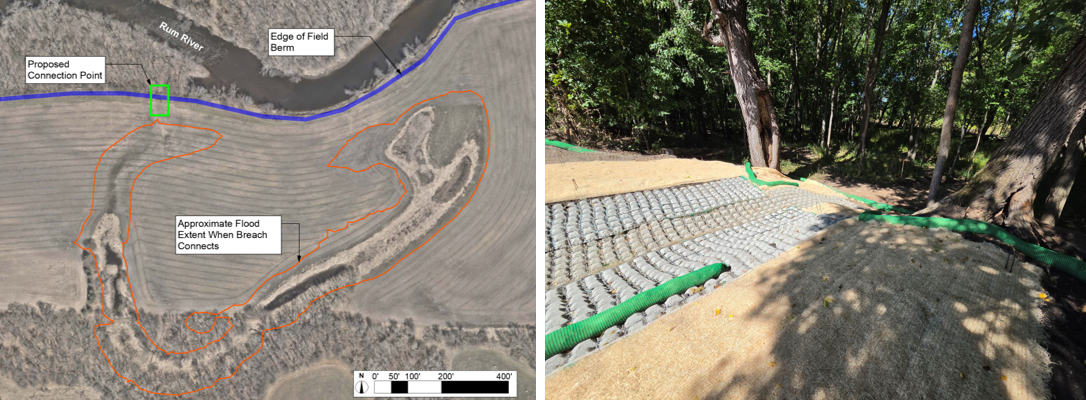
As rivers wind and cut new paths across the landscape, they leave behind curved depressions called "oxbows". Though these old segments of river channel have been cut off, they continue to serve important hydrologic and ecological functions. In natural settings, they hold water to reduce flooding and provide seasonal wetland habitat. Often, due to ditching, these oxbows are artificially separated from the river during high water, or drained so they do not hold water as long.

ACD staff are in the process of implementing two oxbow enhancement projects along the Rum River. The first is at a new conservation easement near the City of Princeton. The second is in Rum River Central Regional Park in Ramsey, MN. The two oxbows are impacted differently but will provide similar benefits once complete. 

Photo: Ziegler oxbow plan (left), Rum Central Regional Park oxbow plan (right).

The oxbow near Princeton has historically been separated from the river via an artificial berm. This berm prevented the river from flooding into the surrounding farm field during periods of high water. This berm improved farm access for planting, but it kept the oxbow dry except during severe flood events. The landowner has placed the field under a conservation easement, with plans to restore the area to prairie and woods. We have partnered with Isanti SWCD, USFWS, and The Nature Conservancy to create a stabilized connection point through the berm that will allow the river to flood into the oxbow every two to five years instead of every fifty.

The Rum River Central Regional Park oxbow is impacted in the opposite way as the Princeton oxbow. This oxbow frequently floods from high river levels, but it was ditched to the river to drain as quickly as possible. We are partnering with Anoka County Parks to install risers on the culverts along the historical ditch, raising the elevation and the duration of water retention. Rather than allowing this oxbow to flood more frequently, we are helping it retain water for longer.

Stay tuned for project updates and photos as construction begins later this year! For more information, contact Jared Wagner, Water Resource Specialist, at This email address is being protected from spambots. You need JavaScript enabled to view it.. 

  320 Hits

Stop the Spread of Emerald Ash Borer!

Photo: MNDNR visual displaying EAB as an adult and as a larva.

You can help contain the spread of Emerald Ash Borer (EAB)!. Avoid cutting or pruning Ash trees from May 1 through September 31, as EAB is most active during this time. Do not transport firewood off the site where it was collected; doing so may release adults into a previously infested area. The Twin Cities metro and much of Eastern MN are within an EAB quarantine zone. Transporting firewood out of this area risks spreading this forest disease. Find more information on ACD's website.

For more information, contact Carrie Taylor, Restoration Ecologist, at This email address is being protected from spambots. You need JavaScript enabled to view it.. 

  289 Hits

ACD Celebrates 35 Years with Manager Chris Lord!

Photo: Chris Lord, ACD's District Manager

We're celebrating a milestone! The Anoka Conservation District's (ACD) Manager, Chris Lord, just reached his 35th anniversary of employment at ACD. Since 1991, he has worked on nearly every facet of our mission to "holistically conserve and enhance Anoka County's natural resources for the benefit of current and future generations through partnerships and innovation." Looking back, the progress and accomplishments are impressive.

In 1991, when Chris started, ACD had a staff of 2 ½ people in a small rental space in a strip mall in Blaine. There were a few green-glowing computer screens and file cabinets. Services were meaningful, but few. In relatively short order, Chris was promoted to District Manager. Under his leadership, ACD today is 13-staff strong, owns its robust facilities, and has dozens of programs that bring millions in grant dollars into the community for conservation. ACD has completed 1,155 projects in just the last 25 years. Projects include nearly 3,000 acres of terrestrial habitat enhanced, over 7 miles of shoreline stabilized, and 1,695 acres of stormwater runoff treated. Water quality projects have spanned 12 lakes, the Rum and Mississippi Rivers, numerous streams, and groundwater.

Partnerships built under Chris' leadership have multiplied the benefits to natural resources. There are six watershed organizations within the county that are key partners. ACD works in collaboration with them all annually and serves as contracted staff for three, reducing duplication and resulting in many shared projects. Regionally, ACD is part of larger groups that span neighboring counties, often those that share a watershed. Because Chris has lived and worked his entire life locally, he also has deep connections with landowners that have led to significant projects.

Innovation has been a key characteristic of Chris' leadership. As one example, he spearheaded efforts that led to the invention, patenting, and now nationwide sale of the Rain Guardian pre-treatment chamber for rain gardens. Not many government agencies also operate a business, but we do! It provides important revenue for conservation work.

ACD's office space is another example of innovation. ACD purchased its office space in 2011 as a foreclosed property. Additional building space was rented to generate enough revenue to cover the mortgage. Today, that mortgage is paid off, and rental income helps support conservation.

Chris has led, mentored, or otherwise touched every program at ACD for 35 years. This includes lake and stream monitoring, wetland regulatory assistance, prairie and woodland enhancements, wetland restorations, rare plant rescues, permanent land protection through easements, shoreline stabilization, stormwater treatment practices, educational video productions, community event displays, critical administrative functions, and much more. Chris' dedication and breadth of expertise are appreciated! Thank you, Chris!

  337 Hits

MNDNR Evaluates Cedar Revetments in Anoka County 

Photo: Anoka County Parks Manager, Quinn Palar, and CPL Program Administrator, Amy Yoelin, walking on top of a Rum Riverbank in Anoka County.

The Rum River has over 7 miles of shoreline with some degree of erosion. Riverbank stabilization practices protect property, enhance shoreline habitat, and improve downstream fisheries by improving water clarity and protecting spawning areas. Cedar tree revetments are among the most cost-effective means of addressing moderate riverbank erosion before it worsens.

Anoka County Parks was awarded a Conservation Partners Legacy grant to install 2,500 feet of cedar revetment on eroding sections of the Rum River. ACD was contracted by Anoka County Parks and completed this work between 2023 and 2025. ACD overdelivered by installing 2,933 feet of revetment within available funds.

Cedar tree revetments use Eastern red cedar trees anchored along an eroding riverbank to slow the current. This decreases erosion and allows silt and sand to deposit. The deposited material forms a seedbed. By the time the cedar trees have decayed, the bank is stabilized by the roots of the living trees. 

Photo: A cedar revetment installed on the Rum Riverbank to slow the current and reduce erosion.

The MNDNR was excited about what they saw and encouraged Anoka County Parks to continue their revetment program, which is now in its 3rd phase. With the support from the state, Anoka County Parks will likely apply for another phase of funding this coming August.

Restoring streambanks and establishing habitat along public riverbanks will benefit the thousands of Anoka County residents who frequent local parks, as well as Rum River enthusiasts each year. For more information, contact Kris Larson, Water Resource Specialist, at This email address is being protected from spambots. You need JavaScript enabled to view it.

  440 Hits