Where the Money Goes

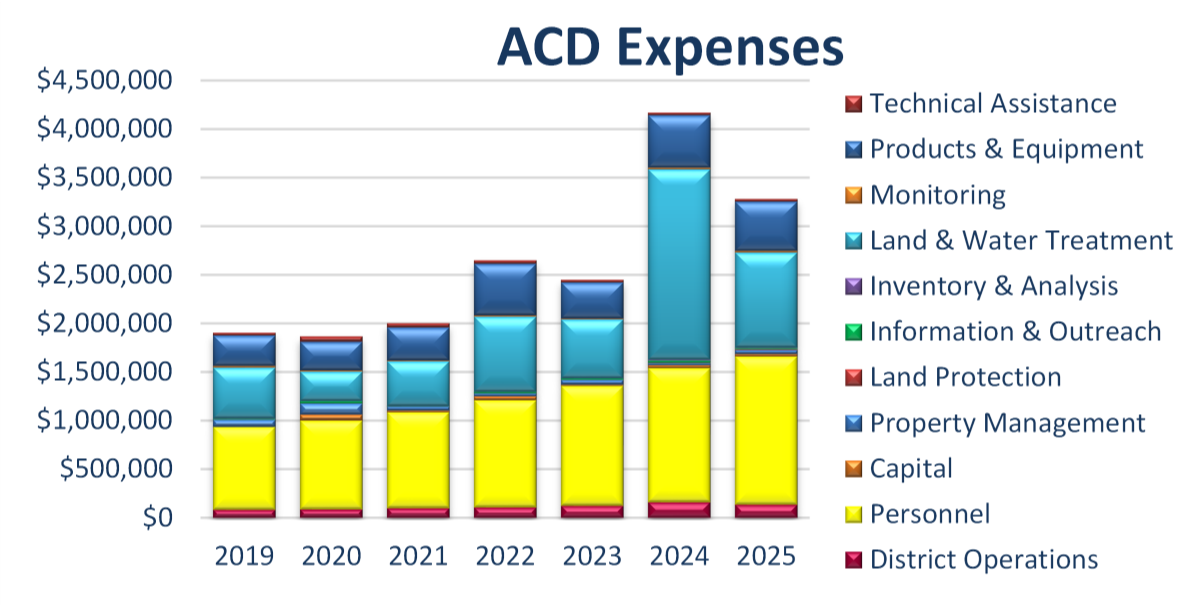
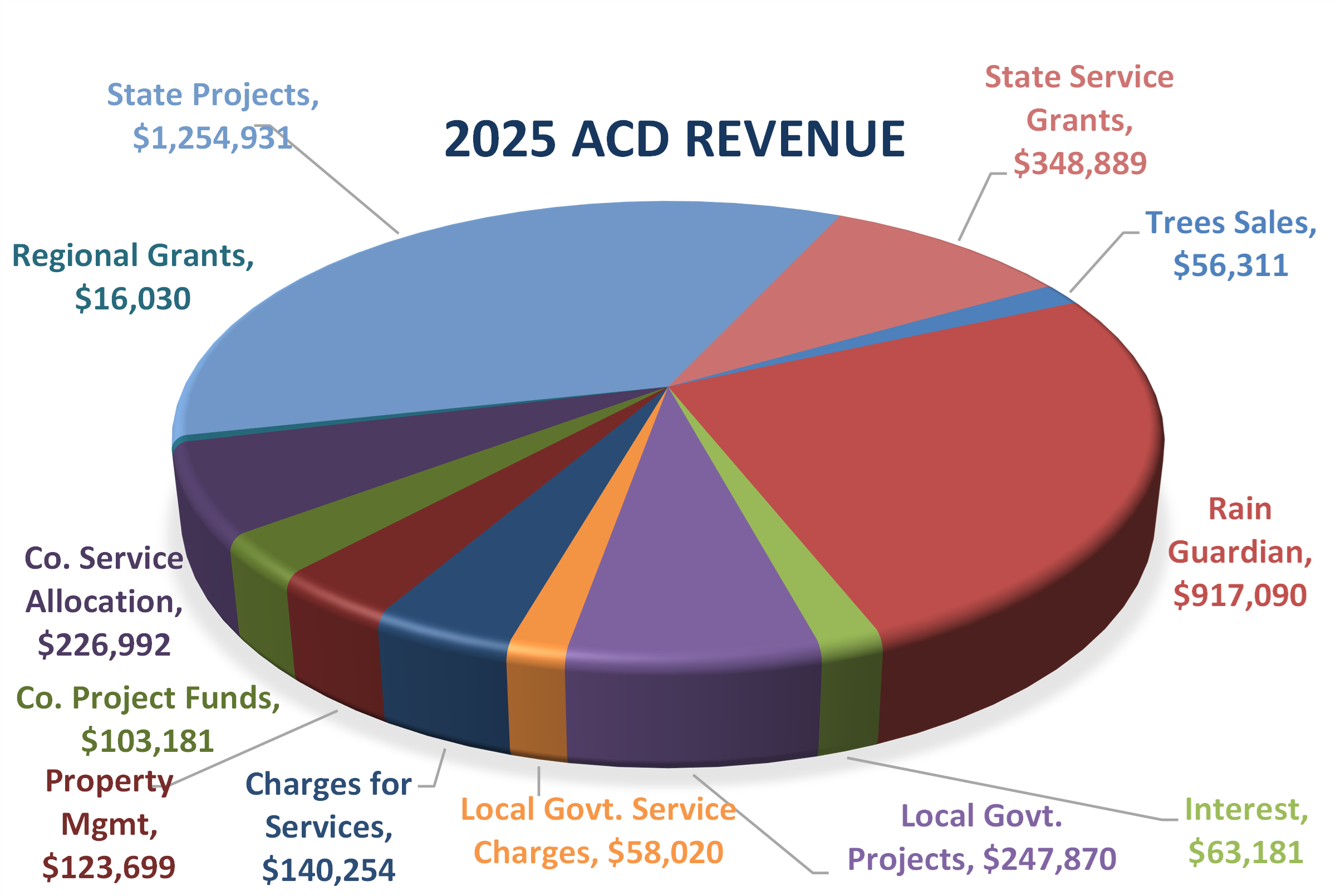
ACD finances vary annually due to the ebb and flow of competitive grants. While ecological projects tend to be installed at a steady pace each year, larger surface-water improvement projects come in fits and starts. The 2025 surface water project planning, design, and permitting set the stage for 2026 installations. Many state grants are funded by sales taxes dedicated to natural resource activities. ACD is committed to accessing these funds to benefit Anoka County taxpayers in proportion to sales tax paid in the county. ACD strives to keep overhead costs down while expanding services. 

Making Sense of the Dollars
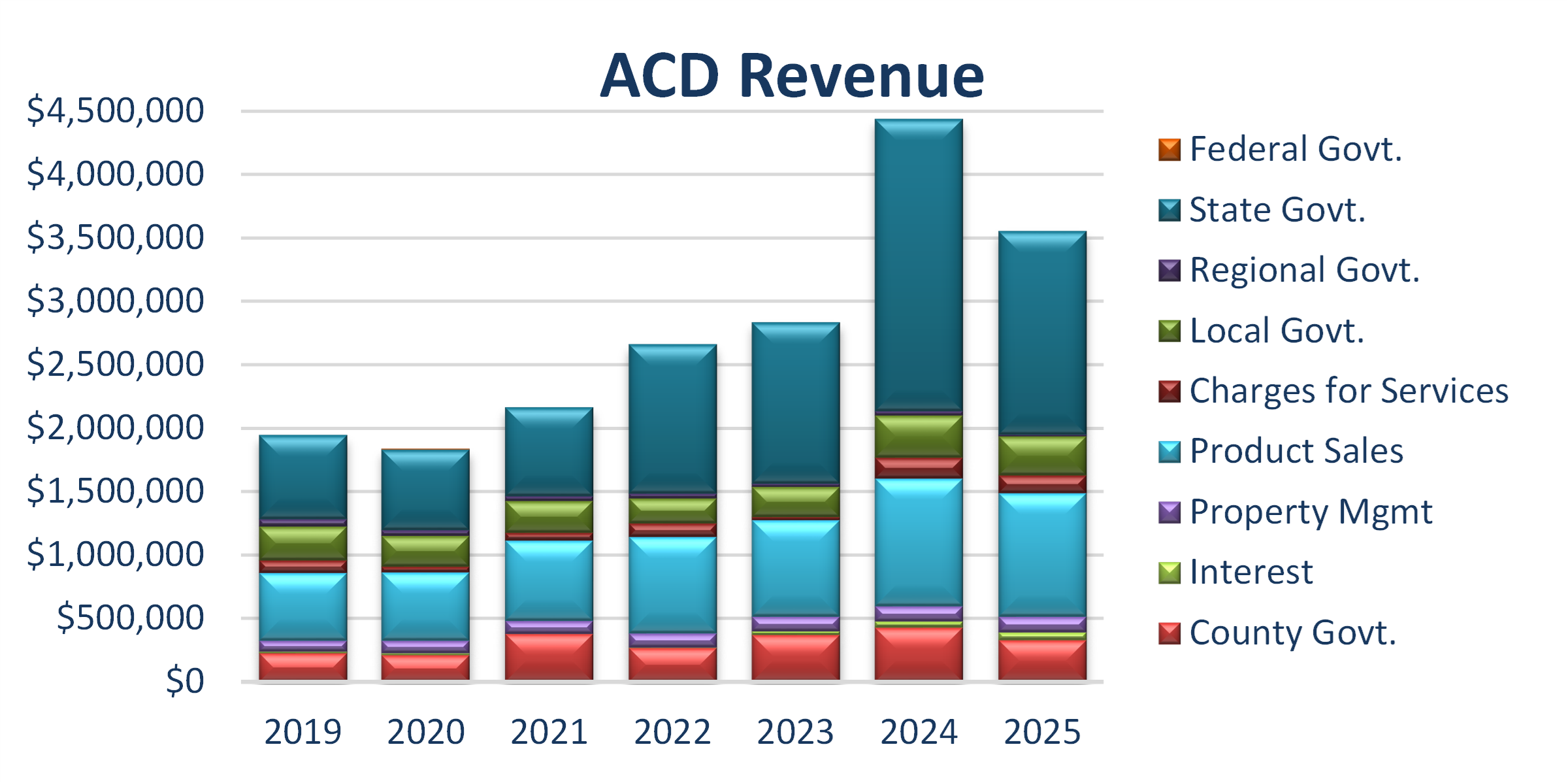
Although governed by an elected board, conservation districts lack taxing authority and must secure funds from multiple sources. Overall revenue decreased in 2025 by nearly $900K, largely due to a decrease in state funds. County funds, while representing a smaller percentage of ACD's budget, are critical to cover general operations because many grants do not cover overhead expenses.

Making Dollars of the Cents
ACD collaborates with cities, watershed management groups, state agencies, county departments, non-profits, and landowners on projects of mutual interest. The 2025 revenue chart begins to convey this but does not show the 122 projects and programs supported by 27 distinct funding sources. On average, for every locally derived dollar, ACD leverages over four dollars from outside the county.

Diversify, Economize, Invest
Among ACD's many funding sources is revenue from the sale of our patented Rain Guardian pretreatment chambers, which exceeded $900K in 2025. Through zero-based budgeting, we annually trim underperforming programs. We also strategically invest to optimize dividend revenues and to enhance our in-house capacity with facilities and equipment.

Interactive Financials Dashboard

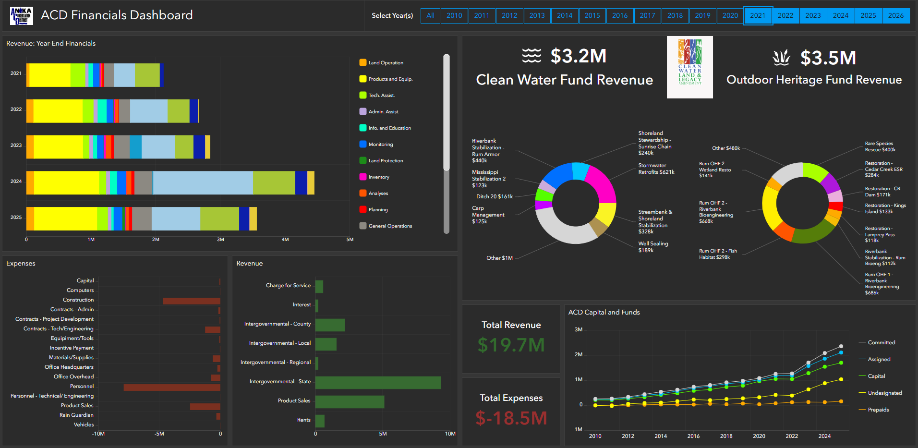
For details on 2025 or prior year financials, explore ACD's interactive financials dashboard (shown above), or review our financial statements and audits at https://anokaswcd.org/about-us/financials.html. For more information contact Chris Lord, District Manager, at This email address is being protected from spambots. You need JavaScript enabled to view it.

  40 Hits

Rolling up Our Sleeves to Protect Mussels

Mussels, often referred to as clams, can be found in many lakes and rivers in Minnesota. Of the 51 freshwater mussel species that have historically lived in Minnesota, 28 are now gone, endangered, threatened, or of special concern. None of them are legal to catch or relocate. If a rare mussel has been identified in an area of a lake or river where a project is proposed, the permit process grinds to a halt. At the same time, experts with specialized certifications are called in, equipped with scuba gear, to carefully locate and relocate mussels from the construction zone. Few people have the necessary expertise and it can take a long time to get one to a job site. The not-so-rare mussels are left to fend for themselves.

All of this intersects with the Anoka Conservation District's (ACD) services, as we often help property owners on lakes and rivers address excessive erosion. Left unchecked, bank erosion can impair water quality, smother wildlife, and damage property and infrastructure. We've been fortunate to avoid all identified rare mussel populations and the permitting challenges that come with them. We started thinking about what would happen if our luck runs out and asked ourselves, "What if we could come up with a way to safely relocate all mussels from all construction zones without hiring Scuba Steve?" We may have come up with a solution that contractors could implement with readily available equipment at a reasonable cost, but first, there are some things you should know about mussels.

Mussels are interesting creatures. When they're born, they must immediately latch onto the gills of a fish, where they live rent-free until they are large enough to drop off and sink into the sand. Each mussel species can only pair up with a specific fish species. Some mussels live over 100 years and most of that time is spent in the top 4 inches of sand and gravel in lakes and rivers. Most mussels prefer to hide in river or lake bottoms with only their mouths sticking out of the sand. Mussels eat by siphoning water and filter out microscopic organisms and plant material that are floating by. They are like HEPA filters, purifying our water bodies. While mussels can move several feet a day to escape dropping water levels, they often spend their entire lives within an area smaller than a kitchen table. They are fairly helpless, except that some local species have such hard and sharp shells that they earned the name heel-splitter, yikes!

We explored numerous ideas before settling on one that we believe has promise. Those left on the cutting room floor included:

  • doing nothing because then all of the mussels would die;
  • excavating out the soil in the construction zone because the mussels would likely be crushed and die;
  • using a rake or sieve because only large mussels could be extracted and the rest would be left to die; and
  • hydro-excavation using an impeller because it's difficult to control and needs an electrical power supply, which near water would set up the operator potentially to die.

All of those options simply involved too much dying. So, we landed on using hydro-excavation, using a high-pressure water pump to blow the top 4" of sand and gravel out into the water and out of the construction zone. 

Photo: ACD staff floating a high-pressure water pump on the Rum River.
Photo: ACD staff placing rebar to measure soil movement in the river.

ACD staff couldn't test this theory on actual mussels because it's illegal to handle and relocate live mussels. Therefore, we chose areas without any known mussels and conducted experiments to determine how effectively we could remove the top layer of soil from the construction zone. Logically, if we could successfully relocate the top 4" if soil out of the construction zone, we would also relocate all of the mussels within that soil. The process involved pumps, hoses, rebar, waders, underwater cameras, tablets, measuring instruments, and talented staff. After much well-documented trial and error, we honed in on a process that did the best overall. This can all be found in a recently completed report, "Mussel Mitigation Techniques: Exploring Sediment Relocation Protocols to Reduce Construction Zone Impacts." Soon, this report will be forwarded to DNR staff who specialize in mussel conservation, where we hope the ideas will be explored, refined, and codified into formal recommendations. With a bit of effort and open-mindedness, perhaps we can end the era of letting the 'not-so-rare' mussels fend for themselves.

This analysis was completed in part with funding from the Outdoor Heritage Fund of the Clean Water, Land, and Legacy Amendment. 

  1408 Hits

Funding for a Groundwater Specialist Remains a Top Priority

The 2026 budget request to Anoka County includes adding a Groundwater Specialist to ACD's staff. This is the third consecutive year that this need has emerged as a top priority. Anoka County has never had a professional dedicated solely to managing our groundwater. Given our situation, it's time to shift our priorities. What situation?  

  • 94% of us in Anoka County rely on groundwater for drinking and other needs
  • We have more private wells than any other county in MN (53,000)
  • We have more Superfunds sites than any other county in MN (9)
  • We sit on the Anoka Sandplain, making our drinking water highly vulnerable to contamination
  • Our shallow groundwater recharges aquifers relied on throughout the Metro Area. 

This combination of factors can come together in troubling ways.

  • Drinking water contamination in Andover neighborhoods near closed landfills.
  • 47 private wells in Blaine and Ham Lake went dry due to interference from municipal well pumping in the City of Blaine. Three Blaine wells had to be shut down.
  • "Forever chemicals" (PFAs) are showing up in groundwater across Minnesota, especially in Anoka County. Potential health ramifications are unknown.
  • Drought diminished shallow groundwater, resulting in record-low lake and river levels.
  • Multiple train derailments across the country exposed the vulnerability of drinking water to contamination by spills. Anoka County must be prepared to respond quickly to spills.

If only we had a Groundwater Specialist at ACD, we could:

  • Develop a groundwater management plan and secure state approval,
  • Secure $150K-$350K/year in state funds available to those with approved groundwater plans,
  • Use advanced technology for high-resolution groundwater modeling,
  • Analyze neglected datasets for hotspots and trends in groundwater degradation,
  • Engage MPCA, MNDNR, and MDH to enhance the service Anoka County constituents receive,
  • Coordinate regional planning, wellhead protection, and contamination response,
  • Implement sentinel well monitoring,
  • Manage cost-share programs for projects like septic upgrades, well sealing, and agricultural irrigation technology upgrades,
  • Inform civic leaders, public employees and the public at large on groundwater, and
  • Serve as the trusted expert on groundwater issues.

If groundwater is a mystery to you, please watch the short videos linked below, which were made locally and are often referenced nationally. 

Groundwater - https://www.youtube.com/watch?v=gxENTkMmyEE

Groundwater Contamination - https://www.youtube.com/watch?v=gRSHJpe8pq8&t=12s 

  1147 Hits

Two Animated Videos Added to the “Our Connection” Series

Our Watershed and Stormwater Connection

This video explains complex concepts about watersheds and stormwater in simple terms using engaging animation. It benefits all ages, from an elementary classroom to a city council chamber. Learn what watersheds are, why they are important, and some challenges watershed managers face. This ties into stormwater management and what public officials are doing to prevent flooding and improve water quality, as well as what we all can do to become part of the solution. https://youtu.be/pqdPe3Lvuao


Our Stormwater Pond Connection

Stormwater ponds are a common feature in many neighborhoods, and for many landowners, they are part of their backyard. This video uses simple terms and engaging animation to explain how stormwater ponds help keep our lakes and rivers clean. It also sets expectations for what is normal for your neighborhood stormwater pond, and perhaps more importantly, what not to expect. The video closes with practical advice on what to do to enhance stormwater ponds.   https://youtu.be/R80kXDOmyq0 

  1718 Hits

ACD's 2024 Financials in Review

Where the Money Goes

ACD finances vary annually due to the ebb and flow of competitive grants. 2024 included several large project installations, funded primarily with state grants. Many state grants are from sales tax dedicated to natural resource activities. ACD is committed to accessing these funds to benefit Anoka County taxpayers in proportion to the sales tax paid in the county. ACD strives to keep overhead costs down while expanding services. 

Making Sense of the Dollars
Although governed by an elected board, conservation districts do not have taxing authority and must secure funds from many sources. State funds increased in 2024 due to several large project installations. Product sales also exceeded $1M for the first time in 2024. County funds are critical for general operations because many grants do not cover overhead expenses.

Making Dollars of the Cents
ACD collaborates with cities, watershed management entities, state agencies, county departments, non-profits, and landowners on projects of mutual interest. On average, for every locally derived dollar, ACD leverages over four dollars from outside the county.

For details on 2024, or prior year financials, explore ACD's interactive financials dashboard, or review our financial statements and audits at https://anokaswcd.org/about-us/financials.html. You can also contact Chris Lord, District Manager, at This email address is being protected from spambots. You need JavaScript enabled to view it.
  1739 Hits