Searching and Surveying for Rare Plants at Cedar Creek Ecosystem Science Reserve
The Anoka Sand Plain (ASP) is a biodiversity hotspot and home to at least 59 species of rare vascular plants in Minnesota. Nearly 20% of the state-listed species occur within the ASP, even though it covers only 2.2% of Minnesota's land area. The ASP is also situated close to a metropolitan center and under continual development pressure, where development plans can impact rare plants. Fortunately, protected lands in the ASP contain high-quality, diverse habitats. These habitats provide an opportunity to study, conserve, protect, and reintroduce ASP rare plant species.
The University of Minnesota Cedar Creek Ecosystem Science Reserve (CCESR) comprises 5,400 acres of protected area located within the ASP. It sits at the boundary of conifer forest, tall-grass prairie, and eastern broadleaf forest and contains a mosaic of plant communities including sedge meadow, wet prairie, rich fen, oak savanna, and fire-dependent forest. This assemblage of communities creates habitat for many rare plant species found in the ASP. There are currently 44 records of 19 rare plants from CCESR in the Natural Heritage Information System (NHIS). However, many of these records and survey dates are several decades old and the current status of these plant occurrences is unclear.
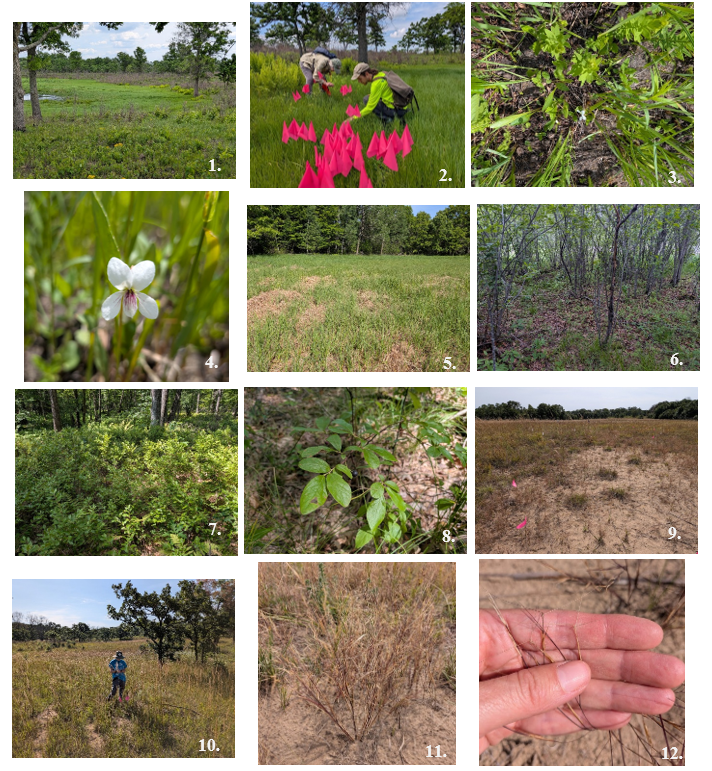
Restoration Ecologist Carrie Taylor from Anoka Conservation District, CCESR interns, and local volunteers are following MN PlantWatch methods to survey and record rare plant observations within Cedar Creek. They started surveys in the spring looking for lance-leaf violet (Viola lanceolata) and have since also looked for beach heather (Hudsonia tomentosa), black huckleberry (Gaylussacia baccata) and seaside three-awn grass (Aristida tuberculosa). Surveys reviewed existing NHIS data, surveyed locations highlighted by MN DNR species-specific habitat models, and documented areas where plants were recently observed but not in the database. Survey results will provide more detailed, current data for DNR's NHIS. The team also documents notes on the plant community and management needs. If a location is suitable as a recipient site for rescued rare plants, then it is also recorded.
Cedar Creek has practiced and researched prescribed burning since the 1960s and has been part of the National Science Foundation Long Term Ecological Research network since 1982. Thus, CCESR has a long history of vegetation data and areas of active management and areas with no management. Survey results, including the absence of rare plants where they once existed, will be correlated with management history within the Reserve. Mapping current rare plant observations, management history (including fire frequency), native plant communities, current invasive species and other threats, and soil types together will help improve understanding of ASP rare plant species' distribution and the impacts of management on these species. The information learned from these surveys will inform future management decisions to help these rare plant populations persist. Additionally, when development threatens rare plant populations within the ASP, there may be opportunities to salvage plants and relocate them to suitable habitats. These surveys will provide more information on appropriate habitats for plant relocations, allowing salvaged plants to thrive. Rare plants are an indicator of the overall ecological health of the habitat; managing for greater diversity of native plants can support more birds, insects and other wildlife species.
Contact Carrie Taylor at