St. Francis High School Biomonitoring Needs a Sponsor!

Photo: St. Francis High School students catching critters in the Rum River. 

ACD is seeking a group, company, or individual to provide $1,000 per year in support for the St. Francis High School biomonitoring program. Our past sponsor has had to withdraw due to financial constraints. Each year, we take high school biology classes to the Rum River to catch and count macroinvertebrates (bugs, crustaceans, etc.) that live there. Because some of these critters require high-quality conditions, we can use them to calculate metrics of river health. It's hands-on education led by professionals, with implications beyond the classroom. This program has been going since 2001. 1,950 students (average 81/yr) have donned waders, grabbed a net, and learned about the Rum River.

Financial assistance is used to help cover the costs of waders, nets, and other necessary equipment. It also ensures that our natural resource professionals can provide instruction and help students discover what their data means. Any group willing to provide financial assistance can please contact This email address is being protected from spambots. You need JavaScript enabled to view it..

  1290 Hits

Grants Available for Soil Health and Conservation Plantings

Funding is intended to incentivize the adoption of new practices. Will not pay for past projects or continuing current practices. Practices that we can currently fund include:
For areas that are not currently row crops. 10-year commitment unless otherwise noted.

  • Conservation cover. This involves planting long-term native plant cover – essentially, a prairie restoration. Pollinator planting falls in this category. Rates are $350 per acre for native species and $500 per acre for pollinator species.
  • Forage and biomass planting. $150/ac
  • Prescribed grazing. $40/ac/yr, 3-year commitment.
For row crop fields. 3-year commitment.
  • Cover crops $50-$60/ac/yr
  • Residue and tillage management. $20/ac/yr
  • Conservation tillage. $10/ac/yr
  • Conservation crop rotation. $30/ac/yr

Contact Jamie Schurbon at This email address is being protected from spambots. You need JavaScript enabled to view it.

  2963 Hits

Grant for Wetland Restoration Will Benefit Typo & Martin Lakes

Photo: A wetland restoration alongside a ditch, similar to the planned project.

Two local lakes and the Sunrise River will benefit from an upcoming wetland restoration project. ACD has secured a $221,375 Clean Water Fund grant, from the Clean Water, Land and Legacy Amendment. The new wetland will receive water from Ditch 20 to remove phosphorus. That nutrient is responsible for "impaired" conditions, including excessive algae blooms, in downstream waters. The project is immediately upstream of Typo Lake, which in turn drains to Martin Lake and the West Branch of the Sunrise River. Construction is anticipated in 2026. For more information contact Jamie Schurbon, Watershed Projects Manager, at This email address is being protected from spambots. You need JavaScript enabled to view it. 

  1491 Hits

Cover Crops Gaining Steam

ACD has its first agricultural cover crop project underway! A landowner in Linwood Township will plant 40 acres of cover crops each of the next three years. The project benefits soil health, water quality, and habitat. Cover crops are planted with a cash crop or after harvest of a cash crop. It's an alternative to leaving the soil bare for nearly half of the year. Cover crops prevent erosion, scavenge nutrients that might otherwise wash away, build soil structure, and increase infiltration. Common cover crops are oats, rye, turnips, and kale. The cover crops are terminated just prior to planting the next cash crop. 

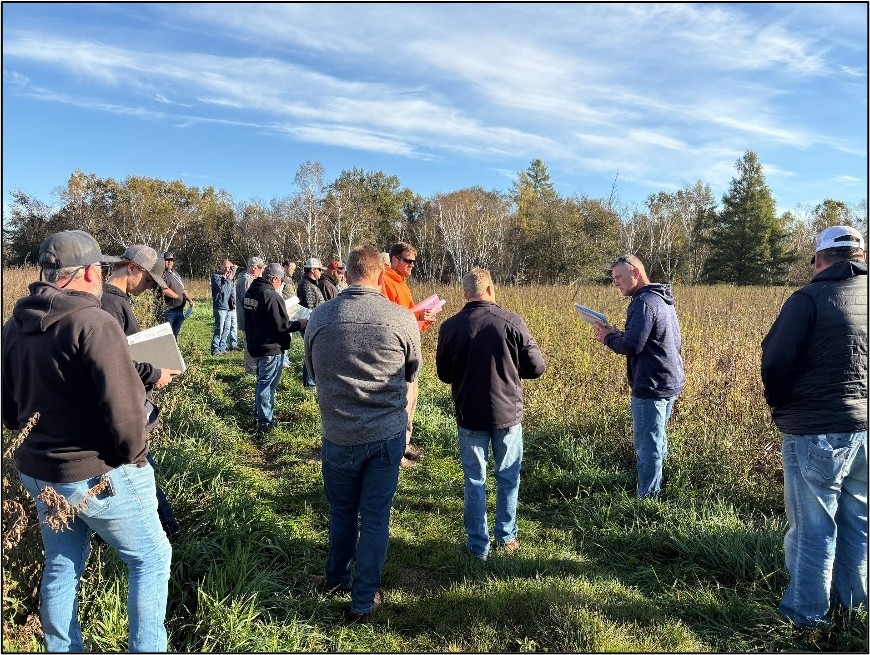
Photo: Cover crop in corn including kale, turnips and oats. Photo is from a recent tour of conservation projects attended by public officials from the Rum River watershed.

To encourage farmers to give cover crops a try, ACD offers incentive payments. These flat rate payments are on a per-acre basis - $50/ac/yr if planting 1-2 species and $60/ac/yr if planting 3+ species. The practice must be implemented annually for three years to qualify for funding. ACD also has incentive payments for other practices including conservation cover, contour buffer strips, filter strips, and no-till/strip-till. For more information contact Jamie Schurbon, Watershed Projects Manager, at This email address is being protected from spambots. You need JavaScript enabled to view it.

  1545 Hits

Replacing Walls on Lakeshores

Photo: Crooked Lakeshore with failed retaining wall. 

ACD recently completed a lakeshore project on Crooked Lake to replace a failing retaining wall. It's one of several such project where tumbling walls left an eroding shoreline. Now, these shorelines are gradually sloped and feature in-lake aquatic emergent plants and an upland native plant buffer. Shoreline walls are prone to failure and are generally not allowed by the MNDNR. Walls on shorelines tend to get undermined by waves and walls also eliminate shoreline features that provide valuable habitat for wildlife. 

Photos: Left - Lakeshore site after grading & installation of riprap, and during geogrid installation to stabilize the shoreline slope. Right - Lakeshore site after construction and planting.

At the Crooked Lake project site, the steep shoreline was addressed with geogrid textile instead of a wall. The honeycomb-like matrix (pictured above) is set just below the soil and helps hold soils in place on steeper slopes. The geogrid is invisible after construction and adds another layer of stability. This Crooked Lake project utilized a new funding source: legislatively approved soil and water conservation district aid. This new funding requires less administration so that we can put more of it into projects. Additional project funding came from the landowners. For more information contact Jamie Schurbon, Watershed Projects Manager, at This email address is being protected from spambots. You need JavaScript enabled to view it. 

  1817 Hits