





New Name, Same Pest

Lymantria Dispar is an invasive moth formerly known by the common name Gypsy Moth. Last year, the Entomological Society of America officially changed the common name for this invasive species to the Spongy Moth. Romani people, Europe's largest ethnic group, generally consider the common name "Gypsy Moth" to contain a racial slur. The Entomological Society of America states that "while the use of an ethnic slur is enough reason to stop using a common name, the former common name was doubly inappropriate in that it linked a group of people who have been treated as pests and the targets of genocide with an invasive pest insect that remains targeted for population control and eradication, all of which combined to have dehumanizing effects for Romani people."  

The new common name for Lymantria Dispar, the spongy moth, refers to the insect's light brown, fuzzy egg masses. This new name also aligns better with other countries common name for this invasive species. This moth is known for defoliating deciduous forests while in their caterpillar form. This repeated defoliation causes stress and can leave trees vulnerable to other diseases and pests. Spongy moths were introduced to the United States from Europe in the nineteenth century. They have spread from their initial location in Massachusetts westward, in both the United States and Canada. 

Since 2004, Minnesota has been a member of the U.S. Forest Service's Slow the Spread (STS) program. Cook and Lake Counties are the only places with reproducing spongy moths in Minnesota. Parts of Eastern Minnesota are within the transition zone, and most of the state is still listed as an uninfested zone. Currently, Anoka County is still within the uninfested zone, but the spread of the spongy moth is occurring at a rate of 3 miles per year.

  3901 Hits

Simple Erosion Control Techniques Brings Success on the Rum River

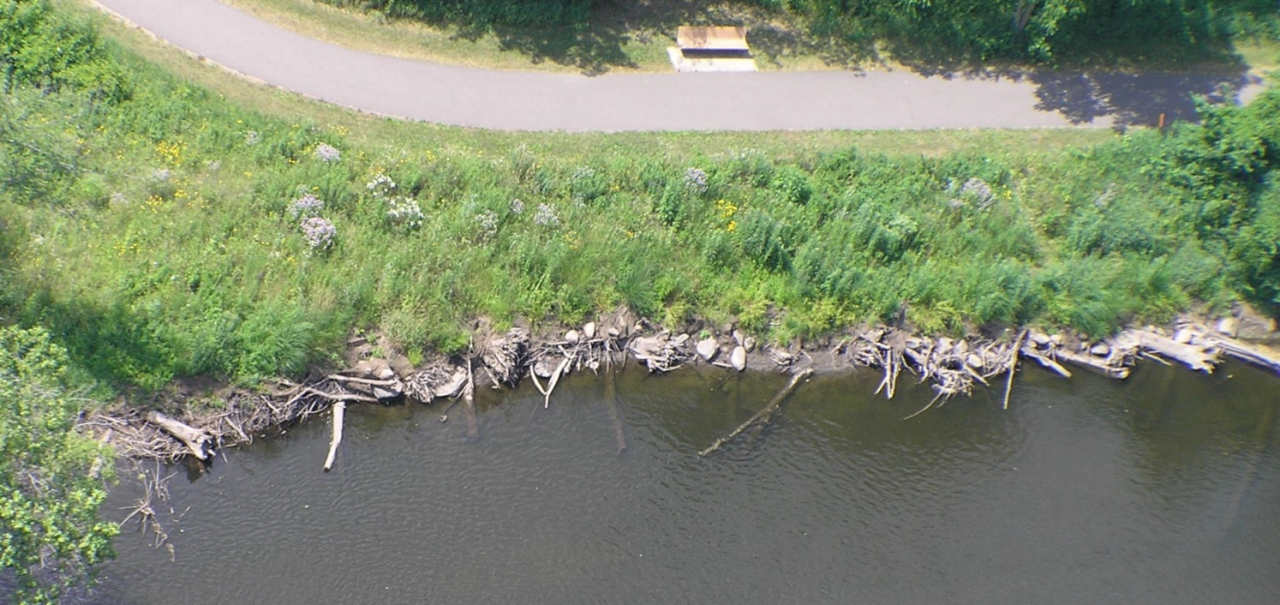
Cedar tree revetments are a cost-effective bioengineering practice that can be used to stabilize actively eroding riverbanks. Excessive erosion along riverbanks threatens property, contributes sediment and nutrients to the water, and eliminates wildlife habitat. Installation of cedar revetments and live stakes, slows or stops the erosion and reduces the likelihood of a much larger and more expensive project in the future.

Eastern red cedars, though native to Minnesota, can be a nuisance species with a habit of taking over and dominating open grassy spaces. These cedar trees can be obtained at little to no cost through land clearing efforts and repurposed to protect streambanks and provide habitat benefit. Efforts made by ACD throughout the last 10-years have resulted in large-scale pollution reduction and extensive land protection along the Scenic Rum River. 

Since 2015, ACD has partnered with landowners, cities, parks departments, schools, and other community groups to install approximately 8,666 linear feet of cedar revetment. At the end of the 10-year project life, the current revetments in Anoka County will prevent in excess of 2,370 tons of sediment and 2,180 lbs of phosphorus from entering the Rum River, based on loading estimates.

Funding for these project was made possible through the Conservation Partners Legacy, Conservation Corps of Minnesota & Iowa crew labor grants funded from the Clean Water, Land, and Legacy Amendment, and contributions from landowners. ACD provided all project administration, design and installation oversight.

  3788 Hits

How Fast Will My Tree Grow?

By far the most frequently asked question as part of our annual tree sale is "how fast will this tree grow?" Simple enough, yet so complicated.

It would be great if we could say "one to two feet per year." That's what customers want to hear. Five feet per year is even better. The truth is more nuanced. A 'slow growing' tree planted in just the right place can easily outgrow a 'fast growing' tree that is planted in the wrong place. Trees can be finicky about how sunny they like it, how wet they want it, how nutrient rich they need it, how cold they can tolerate, or how salty they will bear.

For example, spruce trees like sunny spots that aren't too wet. Never a very fast growing tree to begin with, if put in the wrong place, they can grow painfully slow. In the photos,15 years ago four 3-foot tall potted Colorado Blue Spruce trees were planted in a row about 25 feet apart. The closest tree in the photo is about 25 feet tall and fairly full. The next is 15 feet tall and not looking too bad. The third is a scraggly 12 feet tall. The fourth is clinging to life and tops out at around 9 feet tall.

All four trees have enough sunlight so that isn't the problem. The best grower is planted in ground that is sandier and about 2 feet higher in elevation than the saddest of the bunch, which is planted in a peaty soil that was once a wetland. From the best to the worst grower, they are planted in progressively wetter areas. The fastest grew 18 inches per year while the slowest grew only 4 inches per year.

This is why when asked "how fast will my tree grow?" we hesitate and then follow with "it depends…" This is also why we include all the information you need to select the right tree for your property as part of our sale. Choose well and your trees will flourish, and if you need a little help, give us a call. 

  3621 Hits

Plant this not that

Spring is around the corner and that means it is time to think about what to plant. Ornamental plants are not native to MN and therefor do not provide as quality of a food source to pollinators or wildlife. Some ornamentals have started to spread to natural areas where they can cause ecological harm. Amur maple, Norway maple and Winged burning bush have been common landscaping plants but their spread into natural areas has been detected. That invasive behavior landed them on the MN Noxious Weed List as Specially Regulated Plants. There are many native plants to choose from that are suitable for landscaping. See the Woody Invasives of the Great Lakes Collaborative website's Landscape Alternatives for native plant ideas. Blue Thumbs Plant Finder is a great tool to determine the best native plants for your site conditions. Many MN natives are available at local plant nurseries.

Avoid

Choose Instead

Amur Maple

Mountain maple, pagoda dogwood, high bush cranberry, fireberry hawthorn

Norway Maple

Red maple, sugar maple, hackberry, basswood

Winged Burning Bush

Leatherwood, pagoda dogwood, nannyberry, wolfberry

  3350 Hits

Rum Watershed Comp Plan Nearly Done!

Counties, soil & water conservation districts, watershed organizations and the Mille Lacs Band of Ojibwe have created a Rum River Comprehensive Watershed Management Plan (CWMP). The plan contains mutual priorities for water quality improvements and other natural resources. State approval of the plan is anticipated for May.

The management plan was created because there are 15+ local water plans managing different parts of the same watershed, making it hard to reach watershed-level goals. The CWMP is a single umbrella plan prioritizing resources across the entire watershed. Activities in the plan include shoreland erosion stabilization, agricultural water quality projects, stormwater treatment, septic system fix ups for low income owners, forestry practices, and more.

Approximately $1M in State Watershed Based Implementation Funds (WBIF) grants are provided every two years to implement the plan. The partnership is forming a joint powers board to direct plan implementation and grant funds use.

The full plan is available at https://www.millelacsswcd.org/rum-river-one-watershed-one-plan/.For more information contact Jamie Schurbon (This email address is being protected from spambots. You need JavaScript enabled to view it. or 763-434-2030 ext. 210). 

  3390 Hits

LAKE GEORGE SHORELINE STABILIZATION PROJECTS IN 2022

Seven lakeshore stabilization project designs are underway for properties on Lake George. ACD staff conducted targeted mailings based on a previously completed erosion inventory and site visits were then conducted at properties with interested landowners. Potential project sites were prioritized by water quality improvement potential, and with the funding available, seven sites were chosen to be developed. Construction of these projects is anticipated for summer, 2022.

Lakeshore stabilization techniques include coir logs, native vegetation buffers, minor regrading of ice heaves, and minimal riprap. The picture to the right shows an eroding shoreline with a short bank height that can be stabilized using a coir log and native vegetation. Stabilization of the lakeshores will reduce pollutant loading to Lake George and thereby provide water quality benefits. The native plant buffer areas will also provide habitat benefits.

Funding is provided by a Rum River Watershed Based Implementation Funding grant and landowner contributions. Watch for additional updates as the projects progress through final design and construction. 

  3342 Hits

Understanding the Minnesota Noxious Weed List

Minnesota's Noxious Weed Law is the policy of the legislature that residents of the state be protected from the injurious effects that noxious weeds have on public health, environment, public roads, crops, livestock, and other property. A noxious weed is a regulated plant species that has been designated as one of the four categories; Prohibited Eradicate, Prohibited Control, Restricted, and Specially Regulated.

The Prohibited Eradicate category include species that are highly damaging with limited distribution. These species are listed with the goal of eradication. Some examples found in Minnesota include Black Swallow-wort, Oriental Bittersweet, and the Tree of Heaven.

The Prohibited Control category include species that are highly damaging and widely distributed. The goal for species in this category is to prevent spreading. Examples in Minnesota include Wild Parsnip, Common Tansy, and Japanese Knotweed.

The Restricted Category include species that are highly damaging with an extensive distribution that limits the ability to control populations. The goal for these species is to prevent new plantings. Examples in Minnesota include Common Buckthorn, Non-Native Honeysuckle, and Garlic Mustard.

Specially Regulated plants may be native, non-native, or demonstrated value. The goal for this category of plants is to craft regulations that prevent issues. Examples in Minnesota include Poison Ivy, Amur Maple, and Winged Burning Bush.

Species on this list and new potential treats are reviewed by the Noxious Weed Advisory Committee. This committee is comprised of members that represent conservation, business, tribes, and government interests. A thorough risk assessment is completed for a species before a listing recommendation is made by the committee. You can report a potential population of a species on the Minnesota Noxious Weed List by taking a picture of both the leaves and flowers, taking note of the location, and sending it to the Arrest the Pest email This email address is being protected from spambots. You need JavaScript enabled to view it. or by filing out the online reporting form on the website https://mdaonbase.mda.state.mn.us/AppNetUF/UnityForm.aspx?key=UFKey.

Below is a list of species to keep a look out for. Some of these species are already listed as Prohibited Eradicate in Minnesota and have very limited distribution. Looking for these species can prevent new populations from invading the state. Other species on the list have not yet been found in Minnesota, but have caused substantial damage in other parts of the country. Early detection and eradication is crucial in protecting Minnesota against invasive species. 

  7790 Hits

It’s time to start native seeds for your pollinator garden!

There is so much magic and joy in starting wildflowers from seeds. This is a good time to start that process for many native plants so that they are ready in the spring. Many native plants' seed stays dormant until there are good conditions in the wild. As a gardener, you can create these conditions to break dormancy for seed germination. Many native seeds need cold moist stratification to germinate. This can be done outdoors if seed is planted in the fall and overwintered. If you want to start them indoors in containers then pre-treatment stratification is needed. Stratify by placing seeds in a damp paper towel, coffee filter, or sand and into a sealed plastic bag in the refrigerator (33-40 °F). Native plant's seeds range from needing 10 to 120 days of cold stratification. Once seeds have been stratified for the number of recommended days, plant seeds in a soil medium. Keep soil moist until seeds sprout and send up their first leaves. Water as needed and allow the soil to begin to dry out between watering. The magic continues as plants continue to grow!

Learn more about individual native plant seed pre-treatment and germination strategies in the Prairie Moon Nursery 2022 Cultural Guide and Germination Guide and the Tallgrass Prairie Center's Native Seed Production Manual.

If you aren't ready to start a new seed starting hobby, this is also a good time to start designing and planning a pollinator garden. Many local plant vendors have their plant catalogues ready for you to view. Be sure that plants you purchase are free of neonicotinoids, which are very toxic to pollinators.

See BWSR's Lawns to Legumes page for garden design templates and list of local native plant vendors. 

  3529 Hits

Grants available for septic system fix-ups!

Grants are available to homeowners to fix struggling, non-compliant septic systems. Septic systems are the underground tank and drain field that treat wastewater from homes where city sewer and water is not available. Grants are available to households meeting low income criteria. Loans are available to most applicants.

A non-compliant septic system can be a problem for owners, or be an obstacle to selling the property. Failure can be dramatic, such as sewage back up. Or a septic system can be deemed non-compliant because it does not have enough vertical separation from the water table. Grants are awarded because failing septic systems threaten groundwater and nearby lakes and streams.

For more information, visit www.AnokaSWCD.org/financial-technical-assistance.html or contact Kris Larson (This email address is being protected from spambots. You need JavaScript enabled to view it. or 763-434-2030 ext. 110). 

  3461 Hits

Think Spring!!

Spring is just around the corner so get your tree order in today. The District offers a wide variety of native stock, including black cherry trees, mixed oak trees, maple trees, and pine trees. The trees and shrubs are sold as bare root seedlings or transplants, ranging from 8" to 24" in height. They may be purchased in bundles of ten for $19.00, or twenty-five for $38, not including tax. Native prairie seed and tree aides are also available. You do not need to be an Anoka County Resident to order. The pick-up is at the ACD Office at the end of April, 1318 McKay Drive NE, Ham Lake, MN 55304.  

  2878 Hits

2021 ACD TECHNICAL ASSISTANCE SUMMARY

ACD staff provide technical assistance for a wide variety of projects each year. Many of the requests for assistance come directly from landowners interested in improving natural resources or addressing concerns on their properties. Technical assistance is also provided for projects in collaboration with county, city, and watershed entity partners. The table to the right summarizes 2021 technical assistance provided by ACD staff.

Assistance begins with a site consultation. Consultations typically include a conversation with the landowner, desktop review of the site using GIS mapping software and available data sets, and a site visit to discuss options. If the landowner is interested in pursuing a project, ACD can provide design and installation oversight services. Maintenance guidance is also provided for previously installed projects.

Additional information about active projects and those previously completed is available on ACD's project tracking map.

https://www.arcgis.com/apps/Shortlist/index.html?appid=d1e76c3d808743c1b149bde24c990894 

  2539 Hits

HydroClim Minnesota

"HydroClim Minnesota" is a new electronic newsletter put out monthly by MNDNR Climatologist Pete Boulay. ACD has partnered with Pete for years to manage a network of precipitation volunteers throughout Anoka County.

"HydroClim Minnesota" summarizes weather conditions and other weather events occurring throughout the state and the resulting impact on water resources. By subscribing to the newsletter you can learn exciting facts such as, a storm event occurring on December 15, 2021 was not only the warmest day ever recorded in the month of December but it also involved Minnesota's first documented tornado for the month of December!

To learn more fun facts about weather in your state visit https://mndnr.gov/hydroclim. 

  2987 Hits

Assistance for Shoreline Erosion

ACD has a number of grant opportunities available for addressing shoreline erosion along both streams and lakes in Anoka County. If you have noticed your lakeshore migrating back on you over time, or perhaps once had a low walkable area along your river frontage that is now gone leaving only a steep drop-off, ACD may be able to help you design and even fund a project to protect your property.

The first step is a site visit to your property by ACD staff. Now is a great time to reach out to ACD to plan a site visit in the spring. We will assess your erosion problems, give you advice on how to address them, and see if your shoreline might fit into one of our various grant programs for financial assistance. Shoreline restoration does far more than just protect your property. It also protects the water resource you live on, and also enhances habitat for all of the wildlife that utilizes that resource! 

  3670 Hits

Start Thinking Spring Conservation!

Current subzero temperatures can make warmer months seem far away, but winter is a great time to begin planning for spring and summer conservation projects at your home. Whether you want to create an oasis for pollinators and other native wildlife or install features that improve local water quality, there are many great informational resources to help you get started.

Create a native vegetation planting plan and control invasive species

Establishing areas of diverse native vegetation and managing invasive plant species produces multiple environmental benefits, including the provision of food and habitat resources for native wildlife and the improvement of local soil and water health, particularly for areas adjacent to rivers, lakes, and wetlands. Sourcing native plants and landscaping services from local experts is the best way to ensure your efforts maximize ecological benefits in your area. 

 Address lawn care needs sustainably

The ways in which we mow, irrigate, and chemically treat our yards can lead to unintended impacts in nearby aquatic and terrestrial ecosystems. This year, consider developing a lawn care regime that strategically targets nutrient and pesticide needs and reduces the need for irrigation.

Participate in community surveys and attend educational events

Winter is a great time to explore environmental topics that pique your interest and inspire you to become involved in backyard conservation efforts. Many of Minnesota's environmental and conservation organizations provide free or low-cost educational opportunities such as webinars and workshops. You can also become involved in natural resource surveys such as those for wildlife, weather, and water quality, which greatly improve our understanding of conservation needs across the state. 

Financial and Technical Assistance

Because environmental benefits produced through conservation practices typically extend beyond the bounds of your property, conservation projects such as lakeshore restorations, riverbank stabilizations, and best management practices for urban or agricultural stormwater runoff may qualify for financial or technical assistance. Seeking out and applying for these opportunities early will help you get a strong head start on spring and summer projects.

  3126 Hits

LOCAL CONSERVATION LEADERS COME TOGETHER AND SHARE IDEAS

Anoka Conservation District (ACD) Supervisors, Mary Jo Truchon, Glenda Meixell, and Colleen Werdien, along with District Manager Chris Lord, attended the Minnesota Association of Soil and Water Conservation Districts (MASWCD) annual meeting for 2021.

The MASWCD convention is a great opportunity for SWCD supervisors and staff to learn more about current natural resource issues in Minnesota. The conference features grassroots initiatives to conserve soil and water resources throughout the state and always provides attendees with new ideas that can be applied on the local level. Keynote speaker, National Geographic Photographer Jim Richardson, presented on the increased strain on the planet in order to feed the growing population and offered a unique opportunity to learn about global agriculture issues and the potential solutions we have to address them.

In addition to sessions on a variety of conservation topics, discussions and votes were held for state natural resource resolutions. Several awards were presented including; Outstanding Community Conservationist Award, Outstanding Forest Steward Award, Minnesota DNR Division of Waters Appreciation Award, and the Outstanding SWCD Employee and Supervisor awards, presented by the Board of Water and Soil Resources. The convention also featured a luncheon, where the SWCD of the Year Award was presented, along with recognition to outstanding conservationists across the state. The City of Anoka was recognized as Anoka County's Outstanding Conservationist for 2021. 

  2667 Hits